The Best Brain Training Apps in 2026, Honestly Compared
Eight brain training apps, checked on the App Store and Google Play in October 2026. What each is best for, what it costs, how much you get free, and what the evidence does and doesn’t say.
Updated 2026-10-07. Ratings and prices from the US App Store and Google Play.
How we picked
There are hundreds of brain apps. We started from the ones people actually search for and use, then checked each on the US App Store and Google Play in October 2026: rating, number of ratings, price, whether there’s a real free option, and whether it’s still being updated. Then we asked a simple question for each one: who is this best for? No app wins every category, ours included.
Two honest notes before the list
We make Memo, which appears at #5. It’s brand new and small, and we say so.
No brain app is medicine. You’ll get better at the games you practice. Evidence that this spills over into everyday memory or prevents decline is limited; see do brain training apps work? Choose the one you enjoy enough to keep opening.
The best brain training apps at a glance
| App | Best for | Free option | Price (App Store, US, Oct 2026) | Rating |
|---|---|---|---|---|
| Lumosity | Most established all-rounder | Fit Test + limited daily games | Premium options $11.99–$89.00 | 4.7 (130k) |
| Elevate | Reading, writing and everyday math | Basic free version | $9.99/mo or $39.99/yr | 4.8 (544k) |
| BrainHQ | Strongest research base | One free exercise a day | $13.99/mo or $94.99/yr | 4.6 (22k) |
| Peak | Variety on a budget | Basic free version | Pro plans $2.99–$34.99 | 4.7 (146k) |
| Memo | A short routine you can finish | Free browser versions; 2 free in app | $4.99/mo or $29.99/yr, 7-day trial | 5.0 (3 ratings) |
| MindPal | Lifetime purchase | Free to use, Pro upgrade | $7.99/mo, $39.99/yr, $99.99 lifetime | 4.7 (86k) |
| NeuroNation | Structured, adaptive courses | Not stated in listing | 3 mo from $41.99; 12 mo from $83.99 | 4.7 (4.5k) |
| Impulse | Biggest game library | 3-day trial only | Weekly from $6.99; lifetime $99.99 | 4.7 (850k) |
1. Lumosity: best all-rounder
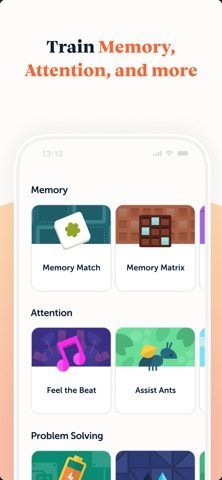
Lumosity is still the reference point. The games are well made, daily workouts adjust to you, and the Fit Test gives you a baseline. It’s rated 4.7 on the App Store (about 130,000 ratings) and 4.8 on Google Play. The catches are a limited free tier and its 2016 FTC settlement over claims it couldn’t back up. Today’s marketing is far more careful, and a separate prescription version, LumosityRx, was FDA-cleared in 2025 for adults with ADHD. Compare it with similar apps in our Lumosity alternatives guide.
Good
- 40+ games across memory, attention, speed, flexibility and problem solving
- Free 10-minute Fit Test with age-group comparison
- Polished, adaptive, and around since 2013 on iPhone
Not so good
- Free tier is a small daily selection
- Premium isn’t cheap
- Settled FTC charges over its advertising in 2016
2. Elevate: best for words and everyday math
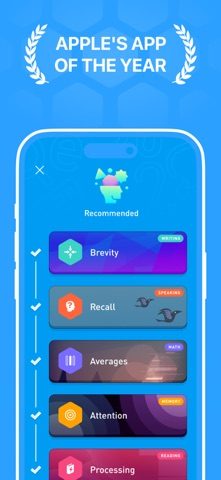
Elevate trains skills you can feel at work: writing clearly, reading faster, doing tips and discounts in your head. It was Apple’s App of the Year, and it’s the highest-rated app here by volume. It costs $9.99 a month or $39.99 a year, and a basic free version is reached by closing the paywall after sign-up. Head-to-head: Lumosity vs Elevate; more options in Elevate alternatives.
Good
- Vocabulary, grammar, reading speed, practical math
- Usable free version
- 4.8 from 544k reviews
Not so good
- Fewer memory and attention games
- Personalized program is paid
3. BrainHQ: best if evidence matters most
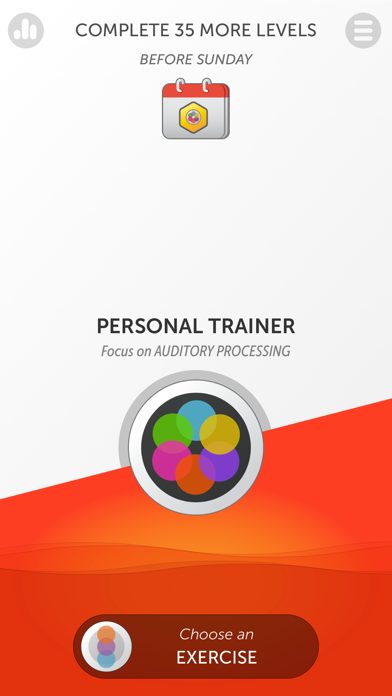
BrainHQ, from Posit Science, is the most research-heavy option. Its “speed of processing” training comes from the line of work behind the ACTIVE trial. In 2026, a 20-year follow-up linked one version of that training, with booster sessions, to fewer dementia diagnoses. That’s one result for one specific kind of training. It doesn’t show that BrainHQ, or any app, prevents dementia, and we explain why on our evidence page. Plans are $13.99 a month or $94.99 a year. If research is your top criterion, it beats everything else here, Memo included. More in is BrainHQ worth it?
Good
- More published research than any other consumer program
- Speed training linked to the 20-year ACTIVE study
- A free exercise every day
Not so good
- Clinical look and feel
- Android app rated 2.9 on Google Play
- $94.99/year
4. Peak: best variety for the money
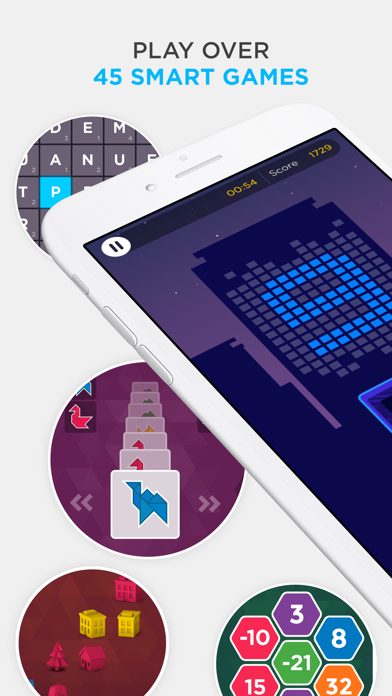
Peak offers a Lumosity-sized library at a lower price. Pro plans on the App Store run from $2.99 to $34.99 depending on the offer, and there’s a free basic version. It’s rated 4.7 from about 146,000 reviews. Originally made by London’s Brainbow, it’s now owned by a games publisher. See Peak alternatives.
Good
- 45+ games, including language and “emotion control”
- Sub-five-minute workouts
- Free basic version
Not so good
- Lots of different prices and offers
- Ownership has changed several times
5. Memo: best short daily routine
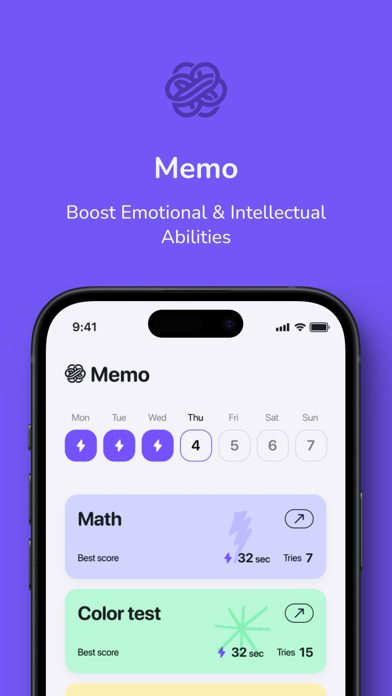
Memo is our app, built for people who never finish a 40-game program. You get eight games, each a minute or two: the Chimp Test for visual memory, a 16-word recall test, a memory matching game, a Stroop test, mental math, a missing-angle geometry puzzle, and two free calm-down tools, box breathing and a Do Nothing timer. The app keeps your best score per game each day, charts improvement against your first try, and has a daily, weekly and all-time leaderboard. It’s in 8 languages. Breathing and Do Nothing are free. Premium unlocks the other six games for $4.99 a month or $29.99 a year, after a 7-day free trial.
Good
- Eight games, about five minutes for the whole set
- Every game playable free in the browser
- Charts your score against your own first try
- Breathing and Do Nothing are free in the app
Not so good
- Brand new: 3 App Store ratings, ~100 Play downloads
- No adaptive difficulty, no language games
- No research of its own
6. MindPal: best for a one-time purchase
MindPal has 4.7 stars from about 86,000 reviews and does the classic brain training app well. What sets it apart is plain pricing, including a lifetime plan: $7.99 a month, $39.99 a year or $99.99 once.
Good
- 40 games across seven skills
- $99.99 lifetime option
- Prices printed in the listing
Not so good
- Less known than the big names
7. NeuroNation: best structured courses
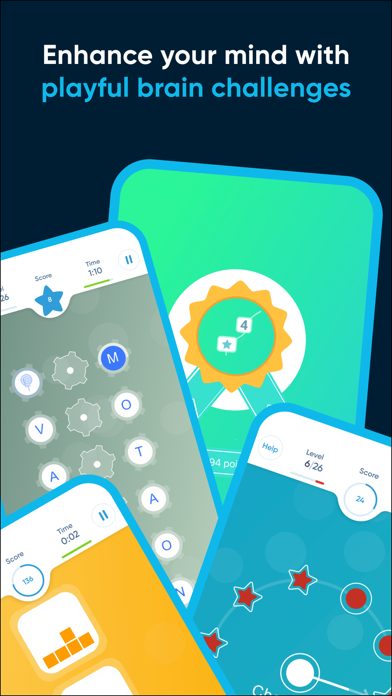
NeuroNation, from Berlin’s Synaptikon, is bigger in Europe than in the US. It has 10M+ downloads on Google Play but about 4,500 US App Store ratings. It builds an adaptive plan from 30+ exercises and lists a Leonardo award for digital prevention among its honors in Germany. Its listing quotes 3 months from $41.99 and 12 months from $83.99.
Good
- 30+ exercises in adaptive courses
- 10M+ Android downloads
- Award-winning in Germany
Not so good
- Short plans are pricey ($13.99/month on 3 months)
- Few US App Store reviews (4.5k)
8. Impulse: biggest library, watch the billing
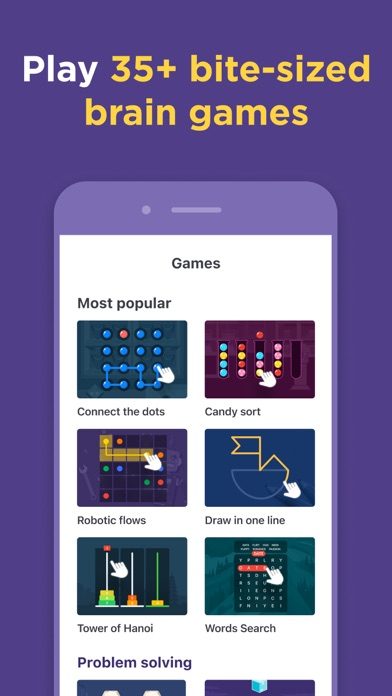
Impulse is the most popular brain app by ratings, and the games are fun. But the 3-day trial leads straight into weekly billing, which costs far more over a year than any yearly plan here. If you try it, set a reminder. Our Impulse alternatives page explains how to cancel.
Good
- 850k App Store ratings
- Dozens of quick games plus quizzes
- $99.99 lifetime plan
Not so good
- No free tier after a 3-day trial
- Weekly plans from $6.99–$9.99 add up
Also worth knowing about
- CogniFit is assessment-heavy and also sells to clinicians and researchers. Its consumer app is rated 4.5 (about 1,700 ratings) on the App Store and 4.0 on Google Play.
- Mind Games has many free games and a one-off $4.99 Pro app instead of a subscription. The iPhone app hasn’t been updated since May 2024.
- Brain It On! and Brain Test show up in “brain game” searches, but they’re puzzle games, not training programs. Fun, but a different thing.
Best by category
- Best free: Elevate’s basic tier, Peak’s free version, or Memo’s browser games.
- Best for older adults: see our brain games for seniors guide.
- Best for memory specifically: see memory games for adults.
- Best evidence: BrainHQ.
- Best value over years: a lifetime plan (MindPal or Impulse at $99.99).
How to get the most out of any of them
- Short and daily beats long and rare. Five to ten minutes a day is plenty.
- Track your own trend, not a leaderboard. Expect a quick rise, then a plateau.
- Mix it up. The real-world benefits people want are better supported by sleep, exercise, learning new skills and time with other people than by any app.
- Try before paying, and set a calendar reminder before any trial ends.
Questions people ask
What is the best brain training app?
It depends on what you want. Lumosity is the best all-rounder, Elevate is best for reading, writing and math, BrainHQ has the strongest research base, and Peak offers the most variety for the price. Memo is a short five-minute daily set you can try free in the browser.
What is the best free brain training app?
Elevate and Peak have basic free versions that don’t expire, BrainHQ gives one free exercise a day, and Lumosity’s free account includes a small daily selection. Memo’s games are free to play in the browser on startwithmemo.com.
Do brain training apps actually work?
You reliably get better at the games you practice. Evidence that this improves everyday memory, work performance or protects against decline is limited and debated. The best-supported result involves a specific speed-training task in the long-running ACTIVE study, not brain games in general.
How much do brain training apps cost?
On the US App Store in October 2026: Memo is $29.99 a year, Elevate $39.99 a year, BrainHQ $94.99 a year, MindPal $39.99 a year or $99.99 lifetime, and Lumosity Premium options run from $11.99 to $89.00. Weekly plans, such as Impulse’s, cost the most over time.
How long should I use a brain training app each day?
Five to fifteen minutes is enough. Daily short sessions are easier to keep up than long weekly ones, and most of the score gain comes in the first few weeks.
Keep reading
- Do Brain Training Apps Actually Work? What the Evidence Says
- Lumosity Alternatives: 6 Brain Training Apps Worth Trying
- The Best Brain Games and Apps for Seniors
- Chimp TestRemember where the numbers were, then tap them in order.
- Stroop testName the ink, not the word — then the rule flips.
- Mental math gameTwelve problems, one clock: warm-ups, carrying, then chains.