Lumosity vs Elevate: Which Brain Training App Should You Pick?
Both have 40+ games and millions of users, but they train very different things. Here’s how Lumosity and Elevate compare on skills, free versions and price, and when Peak, Impulse or Memo fits better.
Updated 2026-10-07. Ratings and prices from the US App Store and Google Play.
The short answer
Pick Lumosity if you want classic brain games: memory grids, attention tasks, quick reactions, problem solving. Pick Elevate if you want to get better with words and numbers you actually use: reading faster, writing clearly, building vocabulary, doing everyday math in your head. Both are polished and highly rated, and both cost about the same order of money. The real question is which skills you want to practice.
Disclosure
We make Memo, which comes up at the end of this page as a third option. Every fact about Lumosity and Elevate here comes from their US App Store listings or their own sites, checked October 2026.
Lumosity vs Elevate side by side
| Lumosity | Elevate | |
|---|---|---|
| Main focus | Memory, attention, speed, problem solving, flexibility | Reading, writing, speaking, vocabulary, everyday math |
| Games | 40+ | 40+ |
| Free version | Fit Test plus a small daily selection of games | Basic free version plus a 7-day trial |
| Price (App Store, US, Oct 2026) | Premium options $11.99–$89.00 | $9.99/month or $39.99/year |
| App Store rating | 4.7 (130k) | 4.8 (544k) |
| Google Play rating | 4.8 (324k) | 4.6 (520k) |
| Adapts to you | Yes | Yes |
| Maker | Lumos Labs | The Mind Company, formerly Elevate Labs |
What each app actually trains
Lumosity: lab tasks turned into games
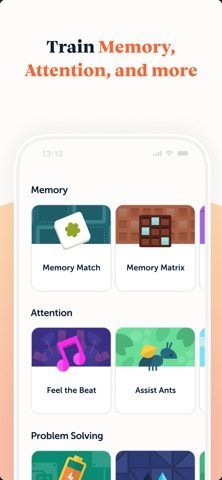
Lumosity’s pitch is that its scientists take established cognitive tasks and turn them into games. You get daily workouts across speed, memory, attention, flexibility, problem solving, math and a few word games. Before you start, a free 10-minute Fit Test sets your baseline and compares you with people your age. Most of the games are abstract: track the moving bird, remember the tiles, switch rules quickly. If you enjoy that kind of puzzle, Lumosity has the most polished version of it.
Elevate: a classroom in your pocket
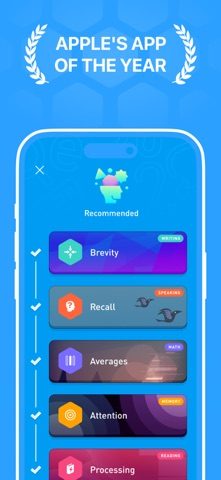
Elevate feels more like school, in a good way. Games drill spelling and punctuation, reading comprehension, how to say what you mean, and practical math like discounts, tips and splitting bills. You choose three to five games a day, and the difficulty adapts as you go. There’s a workout calendar that tracks streaks. If you write a lot at work, or English isn’t your first language and you want to sharpen it, Elevate is much more useful day to day than abstract memory games.
Lumosity: strengths and weaknesses
Lumosity’s history matters here. In January 2016 it settled FTC charges that it had advertised, without enough evidence, that its games could improve work and school performance and delay dementia. It paid $2 million, with a $50 million judgment suspended. Its marketing is far more careful today, and in December 2025 a separate prescription version, LumosityRx, was FDA-cleared for adults with ADHD. That clearance doesn’t extend to the regular app.
Good
- The broadest set of memory and attention games
- Free Fit Test with age-group comparison
- Best Google Play rating of the two
Not so good
- Free version is very limited
- Few language or writing games
- Paid $2M to settle FTC advertising charges in 2016
Elevate: strengths and weaknesses
Elevate was Apple’s App of the Year, and it has the larger review count of the two: about 544,000 on the US App Store. Its store listing says over 90% of frequent users report better vocabulary, math and sharpness. That’s a survey of users, not a controlled study, so read it as “people like it” rather than proof. To find the free version, the listing says to tap the X in the top-left corner after you create an account.
Good
- Clearly useful skills: writing, reading, math
- Usable basic free version
- Cheapest published yearly price of the two
Not so good
- Thinner on memory and attention
- Its “90%+ report improvement” line is self-reported
Price, in detail
Both apps sell through the App Store and Google Play, and both run promotions, so the price you see can differ from a friend’s. Here’s what the US App Store listed in October 2026:
- Elevate: $9.99 for a month, $39.99 for a year (with a 7-day trial). The listing also shows other options between $4.99 and $21.99.
- Lumosity: Premium options from $11.99 up to $89.00, including a one-month subscription at $14.99. The app shows which plan and period you’re buying before you confirm.
On published numbers, Elevate’s yearly plan is the cheaper of the two. Whichever you choose, the yearly plan beats paying monthly if you’re sure you’ll keep using it. If you’re not sure, start with the free tier for a week. Both renew automatically, and you cancel in your phone’s subscription settings, not by deleting the app.
Lumosity vs Elevate vs Impulse
A lot of people add Impulse to this comparison because it has the most ratings of any brain app. It plays more like Lumosity than Elevate, with lots of short memory, attention and math games, plus quizzes. The big difference is billing. Impulse has no free tier after a 3-day trial, and its weekly plans start at $6.99. If you want the Lumosity style with a gentler price, Peak is usually the better third option.
Which one should you choose?
- You want to remember more and react faster: Lumosity.
- You want to write and speak better: Elevate.
- You want the best free experience: Elevate. Its basic tier is more usable.
- You want both kinds of practice: use Elevate’s free tier and add a memory app.
Whichever you pick, don’t expect either one to make you smarter at everything. Research consistently shows people improve on what they practice, and much less on anything else. Our page on whether brain training apps work goes through the evidence.
If neither fits: Peak, Impulse or Memo
People searching “Lumosity vs Elevate” often also compare Peak and Impulse.
- Peak sits between the two. It has 45+ games including language and “emotion control” categories, a free basic version, and Pro plans listed between $2.99 and $34.99 on the App Store. Its rating is 4.7 from about 146,000 reviews.
- Impulse has the most ratings of any brain app, about 850,000 at 4.7. But it has no ongoing free tier: a 3-day trial leads into weekly billing from $6.99. See our Impulse alternatives page.
- Memo is our app, and it’s the small one: eight games, about five minutes a day, and only 3 App Store ratings because it’s brand new. It covers memory (the Chimp Test, word recall, card matching), attention (a Stroop test), mental math and geometry, plus free breathing and “do nothing” timers. It has no language games, so it’s no replacement for Elevate. It also has no adaptive difficulty. What it does well is short and finishable, and you can play every game free in your browser first. Breathing and Do Nothing are free. Premium unlocks the other six games for $4.99 a month or $29.99 a year, after a 7-day free trial.
For the full field, see our Lumosity alternatives and best brain training apps guides.
Questions people ask
Is Elevate or Lumosity better for memory?
Lumosity. Most of its games target memory, attention and speed. Elevate does include memory games, but its focus is reading, writing, speaking and everyday math.
Which is cheaper, Lumosity or Elevate?
On the US App Store in October 2026, Elevate lists $9.99 a month and $39.99 a year. Lumosity Premium options are listed from $11.99 up to $89.00. Both run promotions, so check the price shown in the app before you confirm.
Do Lumosity and Elevate have free versions?
Both do. Lumosity’s free account gives you the Fit Test and a small daily selection of games. Elevate has a basic free version alongside its 7-day trial; you reach it by closing the paywall after signing up.
Is Elevate scientifically proven?
Elevate says its games are designed with neuroscience and learning experts, and that most frequent users report improvement. That’s a user survey, not a controlled trial. As with all brain games, expect to get better at what you practice.
What about Lumosity vs Peak?
Peak is the most Lumosity-like alternative: 45+ games, a free basic version, and Pro plans listed between $2.99 and $34.99 on the US App Store. If you like Lumosity’s style but not its price, try Peak first.
Keep reading
- Lumosity Alternatives: 6 Brain Training Apps Worth Trying
- The Best Brain Training Apps in 2026, Honestly Compared
- Do Brain Training Apps Actually Work? What the Evidence Says
- Chimp TestRemember where the numbers were, then tap them in order.
- Mental math gameTwelve problems, one clock: warm-ups, carrying, then chains.