Memory Games for Adults: 8 Types, and Where to Play Them
Spatial memory, word lists, card matching, n-back: different memory games train different things. Here’s what each one does, how to get better at it, and three you can play free right now.
Updated 2026-10-07. Ratings and prices from the US App Store and Google Play.
Memory isn’t one thing
“Memory games” covers very different skills. Remembering where things are is not the same as remembering words, and both differ from juggling information in your head while you use it (psychologists call that working memory). The best way to choose a memory game is to know which kind you’re practicing. Below are the main types, what each one trains, and where you can play. Three of them you can play free right here, no sign-up.
1. The Chimp Test: remembering positions in order
Numbers appear on a grid. You tap 1, the rest turn blank, and you tap the hidden tiles in order. Each round you clear adds a number. It trains visuospatial working memory, holding several locations and their order for a few seconds. It’s named after Ayumu, a chimpanzee in a 2007 Kyoto University study who beat students at a fast version of it.
Play it: the free Chimp Test. Memo’s version gives you 3 lives and no timer while you memorize. Tip: trace one path from 1 to the end before you tap.
2. Word recall: remembering a list
You study a list of words, then write down as many as you can remember. It’s a classic test of verbal short-term memory, and the skill is close to everyday tasks like remembering a shopping list. In Memo’s version you get 16 words, four from each of four categories, up to 60 seconds to study, and then you type what you recall.
Play it: the free word recall test. Tip: sort the words into their categories as you read. Four groups of four are far easier to recall than sixteen loose words.
3. Card matching: the “concentration” game
The game most of us played as kids: cards face down, flip two at a time, find the pairs. The adult version gets harder with abstract patterns you can’t name. In Memo’s Mind Flip, 12 cards (6 pairs) are shown for 2.5 seconds and then flipped. You score by finding all pairs in the fewest flips.
Play it: the free memory matching game. Tip: in that first glimpse, try to lock in just two or three pairs rather than the whole board.
4. N-back and dual n-back
You see (or hear) a stream of items and press a button when the current one matches the one n steps back. In dual n-back you track a position and a spoken letter at the same time. It is hard, and that’s the point: it’s a pure working memory workout. Dual n-back became famous for claims it could raise intelligence. A 2015 meta-analysis found a small effect. A re-analysis found it shrank further and wasn’t reliable once studies with active control groups were considered. Play it because you like the challenge, not to raise your IQ. Memo doesn’t include an n-back game.
5. Digit span
Someone reads a string of digits, and you repeat them. Then you try repeating them backwards. It has been used in psychology for over a century. Most adults manage around six or seven digits forward and fewer backward. Backward span leans more on working memory, because you have to rearrange as you go. Tip: group digits in threes, the way you remember phone numbers.
6. Corsi blocks and Simon-style sequences
In the Corsi block test, an examiner taps a sequence of blocks and you repeat it. The span you reach is your spatial memory span. The electronic game Simon does the same with colors and sounds, adding one step each round. Both are cousins of the Chimp Test, which shows everything at once and lets you set the pace.
7. Schulte tables (a focus game, often lumped in)
A 5×5 grid of shuffled numbers. You find 1 to 25 in order as fast as you can, keeping your eyes on the center. It’s mostly visual attention and search rather than memory, but it shows up in a lot of memory-app lineups. If attention is what you want to practice, the Stroop test trains a related skill: ignoring the obvious answer to give the right one.
8. Mental math (memory in disguise)
Adding 47 and 38 in your head means holding a carried digit while you do the next step. That’s working memory under load. Memo’s mental math games build from warm-ups to two-digit carrying and three-number chains.
What these games will and won’t do
Practice any of these and your score will climb, often quickly at first. That’s real, but it’s mostly getting better at that game. Big reviews of the research find much weaker evidence that it improves memory in daily life. For everyday memory, the techniques below help more. See do brain training apps work?
Memory techniques that work outside games
- Chunking: group items (digits in threes, words by category). It works in games and in life.
- Testing yourself: trying to recall something strengthens it more than re-reading.
- Spacing: review the same thing over several days, not all at once.
- Memory palace: picture items placed along a familiar route. It’s the technique memory competitors use.
- Sleep: memories consolidate overnight. A bad night shows up in every score.
The best memory game apps for adults
If you want these games on your phone with progress tracking, here are the main options (ratings and prices from the US App Store, October 2026). We make Memo.
| App | Memory games | Free option | Rating |
|---|---|---|---|
| Memo | Chimp Test, word recall, card matching, plus attention and math | Free browser versions | 5.0 (3 ratings) |
| Lumosity | Many memory games among 40+ | Limited daily games | 4.7 (130k) |
| Peak | Memory is one of six categories, 45+ games | Basic free version | 4.7 (146k) |
| MindPal | Memory is one of seven skills, 40 games | Free to use, Pro upgrade | 4.7 (86k) |
| BrainHQ | Memory and speed exercises with research behind them | One free exercise a day | 4.6 (22k) |
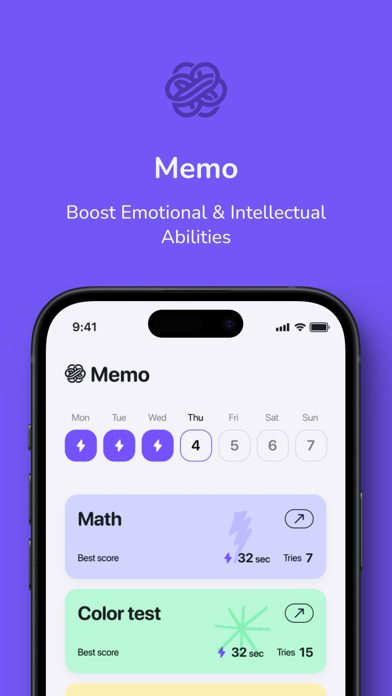
Memo: three memory games in a five-minute set
Memo bundles the Chimp Test, word recall and Mind Flip with a Stroop test, mental math, geometry and two calm-down timers. That’s a mix of memory types rather than one drilled over and over. A full round takes about five minutes. There’s no adaptive difficulty: the games stay the same, so your chart shows real change against your first try. Breathing and Do Nothing are free. Premium unlocks the other six games for $4.99 a month or $29.99 a year, after a 7-day free trial.
Good
- Three different kinds of memory: spatial, verbal, visual
- Daily best score per game, charted against your first try
- Leaderboard for today, this week and all time
Not so good
- Only 8 games in total
- No n-back or digit span
- Brand new: 3 App Store ratings
For broader comparisons, see the best brain training apps and, for older players, brain games for seniors.
Questions people ask
What are good memory games for adults?
The Chimp Test (positions in order), word recall (lists of words), card matching, n-back, digit span and Simon-style sequences are the classics. Each trains a slightly different kind of memory, so a mix is more interesting than one game.
Can memory games improve your memory?
They reliably improve your score on the games you play. Evidence that this carries over to everyday memory is limited. Techniques like chunking, testing yourself, spacing reviews and good sleep do more for daily memory.
Does dual n-back increase IQ?
Probably not in any meaningful way. A 2015 meta-analysis found a small effect on fluid intelligence tests, but a re-analysis found it smaller still and not reliable in studies with active control groups.
What is a normal digit span for adults?
Most adults can repeat about six or seven digits forward and fewer backward. It varies with age, practice and attention, and a single score isn’t a diagnosis of anything.
Are there free memory games for adults online?
Yes. The Chimp Test, word recall test and memory matching game on startwithmemo.com are free in the browser with no sign-up.
Keep reading
- Chimp TestRemember where the numbers were, then tap them in order.
- The Best Brain Training Apps in 2026, Honestly Compared
- Do Brain Training Apps Actually Work? What the Evidence Says
- The Best Brain Games and Apps for Seniors
- Word recall testStudy 16 words for a minute, then type back all you remember.
- Memory matching gameSix pairs, a 2.5-second preview, as few flips as you can.